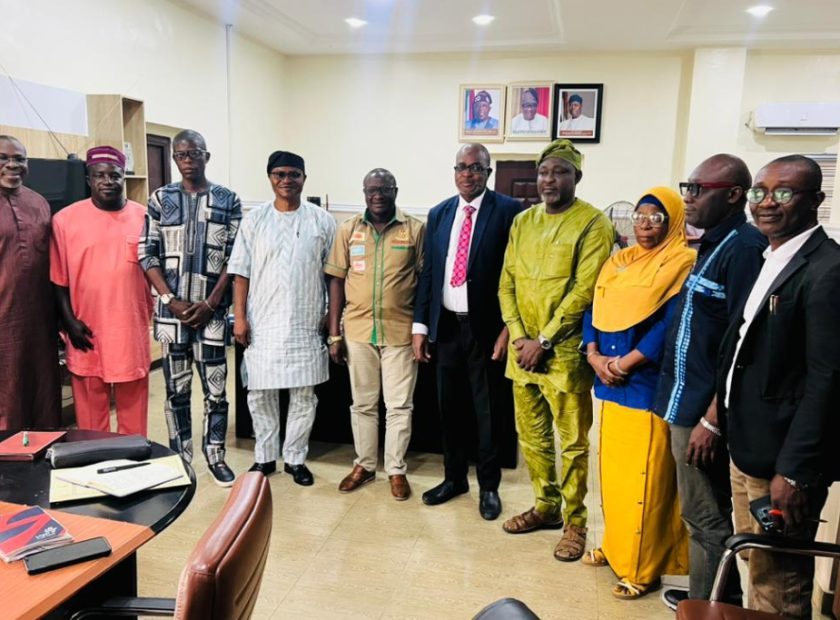
The Oyo State Government has joined the Federal Government and other stakeholders in advancing the digital transformation and reform of Nigeria’s cooperative sector, with the State represented at the National Technical Workshop on Cooperative Sector Digitalization and the MoU Signing Ceremony in Abuja.
The two-day workshop, holding on Tuesday, August 11 and Wednesday, August 12, 2026, at Ladi Kwali Acacia Hall, Abuja Continental Hotel, Abuja, is being organised under the Federal Government’s Renewed Hope Cooperative Reform and Revamp Programme (RH-CRRP 2025–2030).
Oyo State’s delegation is led by the Director of Cooperatives in the Ministry of Investment, Trade, Cooperatives and Industry, Mr. Idowu Olawoyin, who is representing the Honourable Commissioner for Investment, Trade, Cooperatives and Industry, Professor Salihu Abdulwaheed Adelabu.
The workshop is focused on the implementation of the National Cooperative Smart Registry (NCSR), Cooperative Verification Number (CVN) and Cooperative Member Identification Number (CoopID), aimed at establishing a more credible, transparent and digitally enabled cooperative ecosystem across Nigeria.
Declaring the workshop open, the Minister of State for Agriculture and Food Security and Supervising Minister of Cooperative Affairs, Senator Dr. Aliyu Sabi Abdullahi, said the digitalisation of the cooperative sector was central to the Federal Government’s efforts to reposition cooperatives as major instruments for economic development, food security, financial inclusion, enterprise development and wealth creation.
Abdullahi said the Renewed Hope Cooperative Reform and Revamp Programme was designed to transform cooperatives from predominantly analogue structures into modern, digitally enabled, transparent, productive and investment-ready institutions.
He explained that the National Cooperative Digital Architecture would provide the foundation for reliable data and improved identification within the cooperative sector through the National Cooperative Smart Registry, Cooperative Verification Number and Cooperative Member Identification Number.
According to the Minister, credible and verifiable data would enable the Government to better understand the cooperative landscape, strengthen regulation, improve planning and facilitate cooperatives’ access to finance, markets and Government interventions.
He stressed that the digitalisation initiative was not merely about technology, but about building a stronger institutional foundation for cooperatives to contribute meaningfully to Nigeria’s economic transformation.
Abdullahi noted that cooperatives had historically played significant roles in Nigeria’s agricultural and economic development, stressing that the Federal Government was determined to restore and strengthen that role under the Renewed Hope Agenda.
He commended the administration of President Bola Ahmed Tinubu for its commitment to repositioning the cooperative sector as a strategic instrument for economic growth, food security, job creation, financial inclusion and poverty reduction, noting that the reform programme reflected the administration’s determination to build a more productive, inclusive and digitally driven economy.
He further emphasised the importance of collaboration among the Federal Government, State Governments, cooperative federations, cooperative societies, development partners, financial institutions and other stakeholders in ensuring the success and sustainability of the reform programme.
The Minister also reiterated the Federal Government’s commitment to improving access to affordable finance for cooperatives, including the proposed Cooperative Bank of Nigeria, while strengthening governance, accountability, capacity development and value-chain participation within the sector.
He urged stakeholders to embrace the digital transformation programme and work collectively to ensure that the reform produces measurable benefits for cooperative members, farmers, entrepreneurs, women, youths and other Nigerians who depend on cooperative institutions for economic empowerment.
The Federal Government had earlier inaugurated a National Steering Committee for the RH-CRRP to coordinate implementation of the programme across the Country. The committee is also expected to facilitate collaboration between Federal and State Governments and support the establishment of State Cooperative Implementation Committees.
For Oyo State, participation in the workshop provides an opportunity to strengthen its cooperation with the Federal Government on cooperative development and to align the State’s cooperative data and systems with the emerging national digital framework.
The development is particularly significant as the Oyo State Government continues to pursue initiatives aimed at improving data management, strengthening economic planning and enhancing access to government support for cooperatives and other organised economic groups across the State.
The development also aligns with the proactive position of the Oyo State Commissioner for Investment, Trade, Cooperatives and Industry, Professor Salihu Abdulwaheed Adelabu, who has consistently advocated for stronger institutional systems, improved data management and modern approaches to strengthening the Department of Cooperatives. His emphasis on accurate data, effective coordination and improved service delivery is particularly relevant to the emerging national cooperative digitalisation framework, which seeks to provide credible and verifiable information on cooperative societies and their members.
The Commissioner’s position reflects Oyo State Government’s readiness to embrace reforms capable of making cooperative societies more organised, accessible to Government interventions and better positioned to contribute to inclusive economic development. The State’s participation in the Abuja workshop therefore underscores its commitment to aligning its cooperative development efforts with emerging national standards and opportunities.
Through its participation, the Oyo State Government is expected to gain further insight into the technical requirements and implementation framework for the NCSR, CVN and CoopID, while exploring opportunities for effective integration of the State’s cooperative records into the national system.
The State Government, under the leadership of Governor Seyi Makinde, remains committed to strengthening the cooperative movement as a platform for inclusive economic development, enterprise growth, employment creation and improved livelihoods for the people of Oyo State.