The Oyo State Government has reaffirmed its commitment to promoting sustainable transportation and clean energy solutions while emphasizing that every investment proposal must undergo comprehensive technical, commercial and legal evaluation before any partnership is considered.
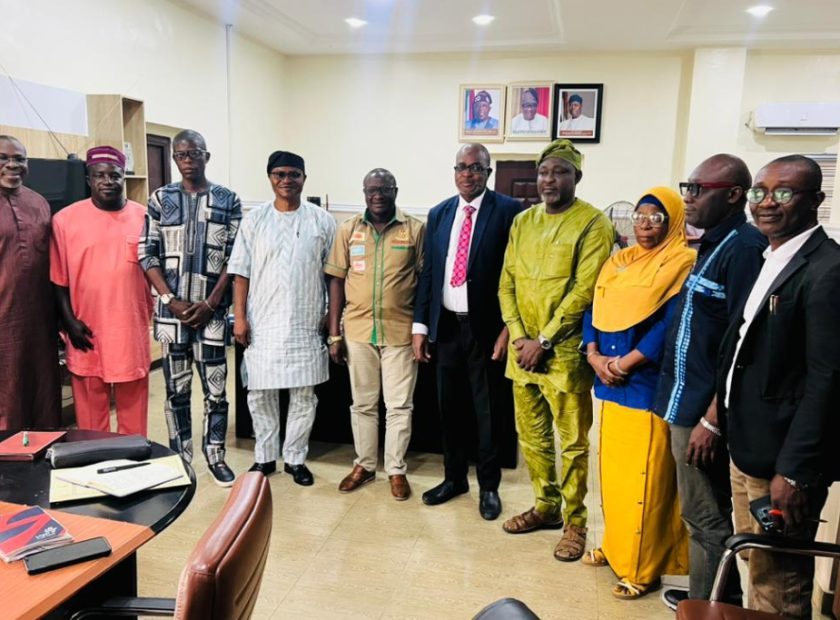
The Honourable Commissioner for Investment, Trade, Cooperatives and Industry, Professor Salihu Abdulwaheed Adelabu, stated this while receiving a delegation from Africa Vehicle Company (AVC), led by the President of the Electric Mobility Promoters Association of Nigeria (EMPAN) Engr. Dapo Adesina and Chief Executive Officer of Africa Vehicle Company, Chief Babatunde Chris Osadahun, at the Ministry’s Conference Room, Secretariat, Ibadan.
The meeting was attended by the representatives of the Park Management System (PMS) for tricycle operators in Oyo State, led by their Chairman Comrade Esho Giwa, traders, cooperators, representatives of the Nigerian Association of Chambers of Commerce, Industry, Mines and Agriculture (NACCIMA); the Babaloja General of Oyo State, Alhaji Abass Yekini Oladapo; and other key stakeholders.
Professor Adelabu commended the concept of electric mobility as a clean, innovative and cost-effective alternative to conventional fuel-powered transportation, describing it as an initiative that aligns with global efforts to promote environmental sustainability, energy efficiency and economic development.
The Commissioner, however, stressed that the Oyo State Government would only support initiatives that demonstrate long-term value, affordability, accessibility and sustainability for the people of Oyo State. He explained that issues relating to product pricing, distribution channels, maintenance structure, charging infrastructure, after-sales support, availability of spare parts, corporate social responsibility, consumer protection and overall implementation strategy must be satisfactorily addressed before any partnership is formalised.
He noted that the Ministry would independently assess the proposal alongside similar products and investment models to ensure that any eventual collaboration offers the best value to the State and prospective beneficiaries.
Professor Adelabu further explained that the initiative has the potential to create economic opportunities for transport operators, cooperatives, entrepreneurs and other investors if properly structured. He added that the Ministry would continue consultations with relevant stakeholders to ensure that any investment model adopted is transparent, practical and beneficial to the people of Oyo State.
Earlier, the Permanent Secretary, Mr. Olajide Mamud Okesade, explained that the engagement was organised to enable the Ministry obtain a comprehensive understanding of the proposed electric mobility initiative before engaging prospective investors and stakeholders.
According to him, the Ministry is primarily interested in evaluating the durability, workability, maintenance requirements, implementation strategy and overall cost-effectiveness of the proposed electric tricycles under the prevailing Nigerian operating environment.
He said the Ministry would carefully examine the suitability of the vehicles for different road conditions across the State, battery lifespan, charging duration, replacement costs, charging infrastructure and the possibility of adapting the technology to local conditions where necessary.
Mr. Okesade added that the Ministry would also explore financing options, including cooperative-based ownership and flexible instalment payment arrangements that could make the tricycles more affordable for operators.
He assured the delegation that the Ministry would continue to engage relevant stakeholders while ensuring that every decision is guided by technical evidence, sustainability and the overall interest of the people of Oyo State.
Presenting the proposal, the President of the Electric Mobility Promoters Association of Nigeria (EMPAN) Engr. Dapo Adesina and Chief Executive Officer of Africa Vehicle Company, Chief Babatunde Chris Osadahun, said the company’s electric tricycles are designed to provide a cleaner, more affordable and environmentally friendly alternative to conventional fuel-powered tricycles.
They disclosed that the tricycles can travel up to 100 kilometres on a single battery charge, significantly reducing daily operating costs when compared with petrol-powered alternatives.
According to them, the company intends to establish a comprehensive support ecosystem through local assembly of the vehicles, training of technicians and roadside mechanics, development of spare-parts distribution networks, and the deployment of charging stations as well as solar-powered battery swap stations to ensure seamless operations.
Chief Osadahun further explained that the initiative would encourage local content development, create employment opportunities, facilitate technology transfer, strengthen technical capacity and contribute to Nigeria’s transition to cleaner, greener and more sustainable transportation.
The highlight of the engagement was the demonstration and test ride of the electric tricycle by the Honourable Commissioner for Investment, Trade, Cooperatives and Industry, Professor Salihu Abdulwaheed Adelabu, alongside the Permanent Secretary, Mr. Olajide Mamud Okesade. Also participating in the ride were the Senior Special Assistant to the Governor on Industry and Cooperatives, Honourable Adeyemo Emmanuel; the Senior Special Assistant to the Governor on Trade and Export Promotion, Honourable Kolawole Ojo; members of the Ministry’s management team; representatives of Africa Vehicle Company; the leadership of the Park Management System (PMS); traders, cooperators and other stakeholders, who witnessed the demonstration of the electric tricycle’s features and operational capabilities.
The initiative aligns with Governor Seyi Makinde’s administration’s commitment to attracting credible investments, promoting industrialisation, supporting innovation, encouraging clean energy solutions and fostering strategic partnerships that will drive economic growth, create employment opportunities and improve the livelihoods of the people of Oyo State.